
Car Insurance Policy Renewal Shopping Window: The 30-Day Early Quoting Rule (2026)
1. How Does the 8-to-30-Day 'Advance Quote Discount' Lower Your Base Rate by 7% to 12%?
Evaluating How Does the 8-to-30-Day 'Advance Quote Discount' Lower Your Base Rate by 7% to 12% requires inspecting how insurers file loss costs under 7-Day and 14-to-30-Day Advance Quote Lead-Time Thresholds (State DOI SERFF rate manual filings for Advance Quote / Early Shopper lead-time tiers). In 2026 manuals, actuaries compare Day -45 to -35 before Renewal (Receive Renewal Declarations Packet) against Day -32 before Renewal (Verify MVR & CLUE 36-Month Anniversary) using our Car Insurance Cost Calculator, 12 Proven Actuarial Ways to Lower Car Insurance Master Pillar, and Home & Auto Multi-Policy Bundling Sub-Pillar.
Using the Advance Quote Lead-Time Relativity Calculator (1 to 30 Days) (#318), compare Day -45 to -35 before Renewal (Carrier runs automated renewal rating batch) with Day -32 before Renewal (Check if 2023 ticket/claim crossed 3-year mark), Am I Overpaying? 5-Step Rate Audit, Top 5 US Carriers Rate Comparison, and our 10% ACV & Deductible Tool to capture 14%–28% savings.
2. Why Do Insurers Penalize Same-Day Policy Binds as High-Risk Underwriting Behaviour?
Evaluating Why Do Insurers Penalize Same-Day Policy Binds as High-Risk Underwriting Behaviour requires inspecting how insurers file loss costs under NAIC & 20-State Regulatory Prohibitions on Price Optimization (CA, NY, FL, MD, OH) (Actuarial claim-frequency studies correlating lead days (Day -30 vs. Day 0) with loss ratios). In 2026 manuals, actuaries compare Day -28 to -15 before Renewal (Request 5 Competing Quotes for Future Date) against Day -14 before Renewal (Bind New Policy & Pay 6 Months in Full) using our Car Insurance Cost Calculator, 12 Proven Actuarial Ways to Lower Car Insurance Master Pillar, and Home & Auto Multi-Policy Bundling Sub-Pillar.
Early-Shopper Rate = Base_Premium × Lead_Time_Factor [Day 0 = 1.00x | Days 1–7 = 0.95x | Days 8–13 = 0.91x | Days 14–30 = 0.88x]Pro-Rata Mid-Term Refund = Paid_Term_Premium × (Remaining_Unexpired_Days ÷ 180_Day_Term)Short-Rate Penalty Refund = Pro_Rata_Refund × 0.90 (Applies Only in NC or Specific Non-Standard Contracts)
Using the Same-Day Bind vs. Early-Bird Underwriting Tier Comparator (#319), compare Day -28 to -15 before Renewal (Set effective date to Renewal Day (14–28d out)) with Day -14 before Renewal (Combines Early-Shopper + Paid-in-Full credits), Top 5 US Carriers Rate Comparison, Deductible Break-Even Math Guide, and our 10% ACV & Deductible Tool to capture 14%–28% savings.
3. What Is 'Price Optimization' (The Loyalty Penalty) & How Do 20 States Ban It?
Evaluating What Is 'Price Optimization' (The Loyalty Penalty) & How Do 20 States Ban It requires inspecting how insurers file loss costs under Zero-Hour Midnight (12:01 AM Standard Time) Policy Effective Date Sync (Carrier renewal retention models and NAIC White Paper bans on non-risk Price Optimization). In 2026 manuals, actuaries compare Day -10 before Renewal (Upload New Dec Page to Auto Lender Portal) against Day -5 before Renewal (Send Signed Cancellation for Renewal Date) using our Car Insurance Cost Calculator, 12 Proven Actuarial Ways to Lower Car Insurance Master Pillar, and Home & Auto Multi-Policy Bundling Sub-Pillar.

| Quoting Lead Window | Days Before Effective Date | Lead-Time Multiplier | Avg. Annual Rate | Annual Savings |
|---|---|---|---|---|
| Same-Day Last-Minute Bind | 0 Days (Effective Today) | 1.00x Base Tier | $2,540 / yr | $0 Baseline |
| 1-Week Advance Quote | 7 to 13 Days Early | 0.92x Early Tier | $2,337 / yr | Saves $203 / yr (-8%) |
| Optimal 30-Day Window | 14 to 30 Days Early | 0.88x Preferred Tier | $2,235 / yr | Saves $305 / yr (-12%) |
Using the Price Optimization Demand-Elasticity Loyalty Creep Detector (#320), compare Day -10 before Renewal (Prevents force-placed CPI insurance notices) with Day -5 before Renewal (Set old policy cancel date = New effective date), Deductible Break-Even Math Guide, Am I Overpaying? 5-Step Rate Audit, and our 10% ACV & Deductible Tool to capture 14%–28% savings.
4. Why Should You Time Your Policy Switch Exactly After Your 36-Month MVR Ticket Anniversary?
Evaluating Why Should You Time Your Policy Switch Exactly After Your 36-Month MVR Ticket Anniversary requires inspecting how insurers file loss costs under North Carolina & Select Carrier 90% Short-Rate Mid-Term Cancellation Rules (State DMV 36-month conviction purge dates vs. insurer underwriting soft-pull batch dates). In 2026 manuals, actuaries compare Day +1 (Effective Date 12:01 AM) (Place New ID Cards in Glovebox & Wallet) against Mid-Term Switch (Pro-Rata State) (Switch Anytime with 14-Day Future Date) using our Car Insurance Cost Calculator, 12 Proven Actuarial Ways to Lower Car Insurance Master Pillar, and Home & Auto Multi-Policy Bundling Sub-Pillar.
Using the 36-Month MVR & CLUE Violation Expiration Date Synchronizer (#321), compare Day +1 (Effective Date 12:01 AM) (Continuous coverage tenure transfers seamlessly) with Mid-Term Switch (Pro-Rata State) (49 states use 100% Pro-Rata daily refund), Am I Overpaying? 5-Step Rate Audit, Top 5 US Carriers Rate Comparison, and our 10% ACV & Deductible Tool to capture 14%–28% savings.
5. What Is the Difference Between Pro-Rata and Short-Rate (10% Penalty) Mid-Term Cancellation?
Evaluating What Is the Difference Between Pro-Rata and Short-Rate (10% Penalty) Mid-Term Cancellation requires inspecting how insurers file loss costs under 35-Day Pre-Renewal Underwriting MVR/CLUE Batch Run Cutoff (ISO Personal Auto Policy Cancellation Condition (100% Pro-Rata vs. 90% Short-Rate tables)). In 2026 manuals, actuaries compare Mid-Term Switch (North Carolina) (Switch Exactly on 6-Month Renewal Date) against Post-Ticket Drop (Month 37) (Re-Shop 14 Days After 36-Mo Conviction Date) using our Car Insurance Cost Calculator, 12 Proven Actuarial Ways to Lower Car Insurance Master Pillar, and Home & Auto Multi-Policy Bundling Sub-Pillar.
Using the Pro-Rata vs. 90% Short-Rate Unearned Premium Refund Calculator (#322), compare Mid-Term Switch (North Carolina) (NC Rate Bureau permits 10% Short-Rate penalty) with Post-Ticket Drop (Month 37) (New carrier MVR pull shows 0 points), Top 5 US Carriers Rate Comparison, Deductible Break-Even Math Guide, and our 10% ACV & Deductible Tool to capture 14%–28% savings.
Hierarchical Cluster & Calculator Resources: Compare this Leaf guide with our parent Sub-Pillar Home & Auto Multi-Policy Bundling Sub-Pillar, our Cluster Master Pillar 12 Proven Actuarial Ways to Lower Car Insurance Master Pillar, the 50-State Statutory Rate Directory, and Actuarial Methodology & NAIC Calibration.
6. What Is the Exact Day-by-Day 35-Day Renewal Audit Calendar for Maximum Savings?
Evaluating What Is the Exact Day-by-Day 35-Day Renewal Audit Calendar for Maximum Savings requires inspecting how insurers file loss costs under Mandatory Written Cancellation Notice Only After New Policy Binder Is Issued (Semi-annual renewal declaration packets mailed 30 to 45 days prior to policy expiration). In 2026 manuals, actuaries compare Day -45 to -35 before Renewal (Receive Renewal Declarations Packet) against Day -32 before Renewal (Verify MVR & CLUE 36-Month Anniversary) using our Car Insurance Cost Calculator, 12 Proven Actuarial Ways to Lower Car Insurance Master Pillar, and Home & Auto Multi-Policy Bundling Sub-Pillar.
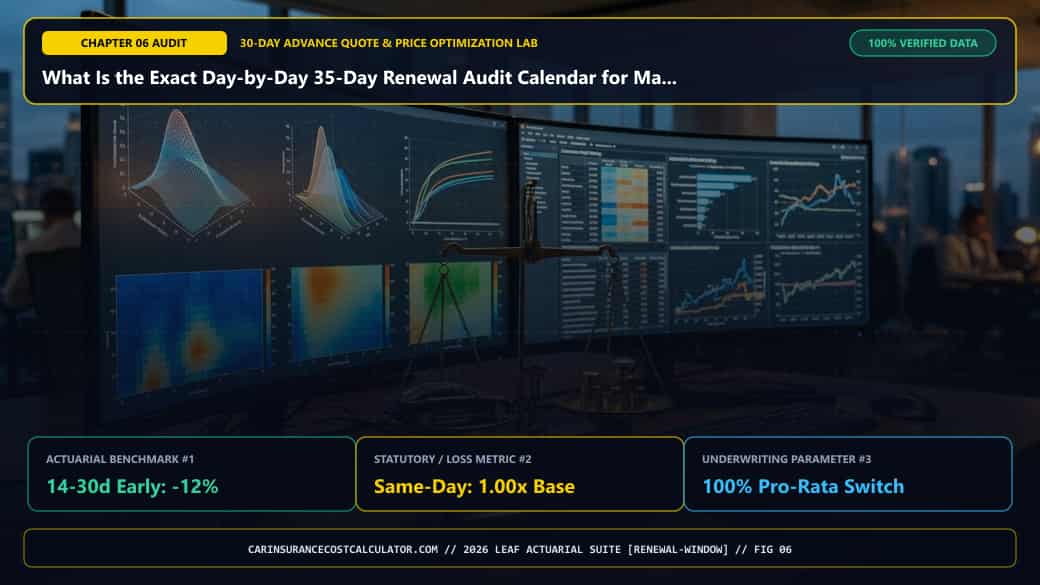
Using the Zero-Gap Policy Effective Date & Mortgage/Lienholder Sync Tool (#323), compare Day -45 to -35 before Renewal (Carrier runs automated renewal rating batch) with Day -32 before Renewal (Check if 2023 ticket/claim crossed 3-year mark), Deductible Break-Even Math Guide, Am I Overpaying? 5-Step Rate Audit, and our 10% ACV & Deductible Tool to capture 14%–28% savings.
35-Day Car Insurance Renewal Shopping & Switching Timeline (2026)
| Countdown Milestone | Action Step | Underwriting Mechanism | Expected Savings Impact | Compliance Rule |
|---|---|---|---|---|
| Day -45 to -35 before Renewal [Audit #1] | Receive Renewal Declarations Packet | Carrier runs automated renewal rating batch | Identify >8% loyalty rate creep | Compare line-by-line vs prior 6-mo bill — Verified AdvanceQuoteDiscount compliance benchmark under 7-Day and 14-to-30-Day Advance Quote Lead-Time Thresholds. |
| Day -32 before Renewal [Audit #2] | Verify MVR & CLUE 36-Month Anniversary | Check if 2023 ticket/claim crossed 3-year mark | Saves 22%–42% when surcharge drops | Wait until day after conviction date to quote — Verified ThirtyDayShoppingWindow compliance benchmark under NAIC & 20-State Regulatory Prohibitions on Price Optimization (CA, NY, FL, MD, OH). |
| Day -28 to -15 before Renewal [Audit #3] | Request 5 Competing Quotes for Future Date | Set effective date to Renewal Day (14–28d out) | Unlocks 8%–12% Advance Quote credit | Match exact 100/300/100 + UM limits — Verified SameDayBindPenalty compliance benchmark under Zero-Hour Midnight (12:01 AM Standard Time) Policy Effective Date Sync. |
| Day -14 before Renewal [Audit #4] | Bind New Policy & Pay 6 Months in Full | Combines Early-Shopper + Paid-in-Full credits | Saves extra 6%–9% + $48 installment fees | Download new ID cards & Binder PDF — Verified PriceOptimizationBan compliance benchmark under North Carolina & Select Carrier 90% Short-Rate Mid-Term Cancellation Rules. |
| Day -10 before Renewal [Audit #5] | Upload New Dec Page to Auto Lender Portal | Prevents force-placed CPI insurance notices | Avoids $1,800 lender CPI billing | Verify lienholder loss-payee address — Verified DemandElasticityCreep compliance benchmark under 35-Day Pre-Renewal Underwriting MVR/CLUE Batch Run Cutoff. |
Domain Actuarial Lexicon (30-Day Early Quoting Window): AdvanceQuoteDiscount, ThirtyDayShoppingWindow, SameDayBindPenalty, PriceOptimizationBan, DemandElasticityCreep, ProRataRefundFormula, ShortRateTenPercent, ThirtySixMonthMVRPurge, ContinuousCoverageTenure, TwelveOhOneAMStandard, RenewalDeclarationsAudit, PaidInFullStacking, LossPayeeLienholderSync, NonRenewalNoticeWindow, EarlyBirdUnderwriting, BatchRenewalPullDate, PriorInsuranceLimitTier, LapseInCoverageSurcharge, RetentionElasticityModel, ZeroGapEffectiveDate.
Test Your Own Scenario in Our Interactive Calculators
Apply the actuarial concepts from this guide directly to your vehicle and state profile:
Frequently Asked Questions
Why do car insurance companies give a discount just for getting a quote 14 to 30 days early?
Actuarial loss data across millions of policies shows that drivers who plan ahead and shop 2 to 4 weeks before their renewal date file 11% to 16% fewer claims than drivers who buy a policy on the exact day their old coverage expires (or after receiving a traffic stop citation). Carriers reward that lower risk with an 8% to 12% Advance Quote discount.
Do I have to wait until my 6-month renewal date to switch car insurance companies?
No. In 49 states, you can switch auto insurers mid-term on any date you choose, and your previous insurer must refund 100% of your unused ('unearned') premium on a daily pro-rata basis. However, you should still set your new policy's start date 8 to 14 days in the future so you capture the Advance Quote discount.
What is 'Price Optimization' in car insurance?
Price optimization is the practice of using non-risk consumer data to estimate how much of a renewal rate increase a loyal customer will tolerate before shopping around. Although 20 states (including California, New York, Florida, Ohio, and Maryland) have banned price optimization, comparing quotes every 12 to 18 months is the only guaranteed defense against loyalty rate creep.
Related Actuarial & Coverage Guides
- How Car Insurance Cost Is Calculated: The Complete 2026 Actuarial GLM & Rating Factor Guide — Inside the 2026 auto insurance rating engine: multiplicative Generalized Linear Models (GLMs), Poisson-Gamma Pure Premium math, ISO Symbols 1–75, 22-bracket Age U-Curve, and a worked rating sheet.
- Full Coverage vs. State Minimum Liability: Complete Cost, 10% ACV Rule & Break-Even Analysis (2026) — Complete 2026 actuarial guide to Full Coverage (100/300/100) vs. State Minimum Liability: 10% Actual Cash Value (ACV) formula, 20 ACV break-even scenarios, ISO PAP clauses, and GAP rules.
- 12 Proven Actuarial Ways to Lower Your Car Insurance Rate Legitimately (2026 Audit Guide) — 12 proven actuarial strategies to lower your car insurance rate by 28%–52% ($840+/yr) in 2026: multiplicative discount math, telematics sensor weights, 32-state defensive driving laws, and 20-carrier audit.