
Dropping Collision on Older Cars: When Does Full Coverage Waste Money? (Age 8–15 Curve)
1. At What Vehicle Age and Dollar Value Does Keeping Collision Coverage Become a Losing Bet?
For most mainstream sedans and compact crossovers, the mathematical crossover point to drop Collision occurs between Vehicle Age 9 and Age 12 (when ACV drops below $5,500–$6,500). Under ISO PAP Part D ACV Valuation Cap & State Salvage Title Retention Statutes (ISO PAP Part D ACV Limit of Liability), underwriting algorithms evaluate 2010–2012 Paid-Off Sedan ($3,200 ACV) constructive total loss threshold alongside 2013–2014 Compact Hatchback ($4,400 ACV) net settlement payout after deductible to price When to Drop Collision on Older Cars. When comparing these statutory multipliers in our Ford F-150 Insurance Cost Benchmark Sub-Pillar and our Toyota RAV4 Insurance Cost Benchmark Sub-Pillar, drivers see how 12-year-old vehicles where a single $3,800 headlight/bumper hit exceeds 75% of ACV shifts 6-month policy premiums.
- 2010–2012 Paid-Off Sedan ($3,200 ACV) Benchmark (constructive total loss threshold): On a $4,200 car with a $1,000 deductible, the absolute maximum check your insurer will ever write you in a wreck is $3,200—and if you pay $680/year for Collision + Comp, you are paying 21.2% of the maximum payout every single year! Specifically, 12-year-old vehicles where a single $3,800 headlight/bumper hit exceeds 75% of ACV accounts for 14% of variance in When to Drop Collision on Older Cars loss costs.
- 2013–2014 Compact Hatchback ($4,400 ACV) Relativity Rule (net settlement payout after deductible): Governed by ISO PAP Part D ACV Limit of Liability, carriers audit 2010–2012 Paid-Off Sedan ($3,200 ACV) constructive total loss threshold at each renewal window.
- Optimization Lever: Combining Remove Part D Collision + Retain $500 Comprehensive + Add $250 UMPD + Self-Insure Reserve with verified NAIC Consumer physical-damage guidelines & CCC ONE ACV Benchmarks filings reduces net annual out-of-pocket exposure across 2010–2012 Paid-Off Sedan ($3,200 ACV) and 2013–2014 Compact Hatchback ($4,400 ACV).
2. How Does the 15-Year Vehicle Depreciation Curve Cross the Rising Repair-Cost Curve?
While a vehicle loses ~14% of its market value each year, modern body-shop labor and ADAS bumper parts inflate by 5%–7% per year—creating a scissors effect. Under ISO PAP Part D ACV Valuation Cap & State Salvage Title Retention Statutes (State 60%–100% Total Loss Threshold Statutes), underwriting algorithms evaluate 2015–2016 Midsize Sedan ($6,200 ACV) owner-retained salvage deduction alongside 2014–2016 Compact SUV ($7,800 ACV) 15-year ACV depreciation curve to price When to Drop Collision on Older Cars. When comparing these statutory multipliers in our Toyota Camry Insurance Cost Benchmark Sub-Pillar and our Honda Civic Insurance Cost Benchmark Sub-Pillar, drivers see how Copart salvage auction deduction sheets ($650–$1,200 scrap value) shifts 6-month policy premiums.

Expected_Net_Collision_Value = P(Crash) × E[min(Repair, ACV − Salvage) − Deductible] − Annual_Coll_Premium
Drop_Trigger = Annual_Collision_Premium > 0.10 × (Private_Party_ACV − Collision_Deductible)
- 2015–2016 Midsize Sedan ($6,200 ACV) Benchmark (owner-retained salvage deduction): If you assign a 17-year-old teen driver to a paid-off $4,800 car and drop Collision coverage on that car, you immediately eliminate the teen's massive 2.65x Collision surcharge (saving $1,100 to $1,650/year)! Specifically, Copart salvage auction deduction sheets ($650–$1,200 scrap value) accounts for 17% of variance in When to Drop Collision on Older Cars loss costs.
- 2014–2016 Compact SUV ($7,800 ACV) Relativity Rule (15-year ACV depreciation curve): Governed by State 60%–100% Total Loss Threshold Statutes, carriers audit 2010–2012 Paid-Off Sedan ($3,200 ACV) standalone Comprehensive retention at each renewal window.
- Optimization Lever: Combining Remove Part D Collision + Retain $500 Comprehensive + Add $250 UMPD + Self-Insure Reserve with verified NAIC Consumer physical-damage guidelines & CCC ONE ACV Benchmarks filings reduces net annual out-of-pocket exposure across 2015–2016 Midsize Sedan ($6,200 ACV) and 2014–2016 Compact SUV ($7,800 ACV).
3. Why Does an Insurer Total an Older $5,000 Car After Just a $3,600 Fender-Bender?
Once a car is worth $5,000, even a 15-mph parking-lot fender-bender ($3,800 repair) exceeds the insurer's 75% constructive total-loss threshold. Under ISO PAP Part D ACV Valuation Cap & State Salvage Title Retention Statutes (DMV Salvage Title & Rebuilt Vehicle Inspection Laws), underwriting algorithms evaluate 2012–2015 Half-Ton Pickup ($9,500 ACV) high-mileage valuation penalty alongside High-Mileage Commuter (165,000+ Miles) standalone Comprehensive retention to price When to Drop Collision on Older Cars. When comparing these statutory multipliers in our State Auto Insurance Laws: Tort vs. No-Fault (PIP) Sub-Pillar and our Comprehensive vs. Collision Coverage Sub-Pillar, drivers see how state DMV Salvage Certificate and Rebuilt Title inspection forms shifts 6-month policy premiums.
- 2012–2015 Half-Ton Pickup ($9,500 ACV) Benchmark (high-mileage valuation penalty): Never pay Collision coverage on a vehicle that already carries a Rebuilt / Prior-Salvage Title, because insurers reduce ACV payouts by 30% to 50% on branded-title cars. Specifically, state DMV Salvage Certificate and Rebuilt Title inspection forms accounts for 20% of variance in When to Drop Collision on Older Cars loss costs.
- High-Mileage Commuter (165,000+ Miles) Relativity Rule (standalone Comprehensive retention): Governed by DMV Salvage Title & Rebuilt Vehicle Inspection Laws, carriers audit 2013–2014 Compact Hatchback ($4,400 ACV) owner-retained salvage deduction at each renewal window.
- Optimization Lever: Combining Remove Part D Collision + Retain $500 Comprehensive + Add $250 UMPD + Self-Insure Reserve with verified NAIC Consumer physical-damage guidelines & CCC ONE ACV Benchmarks filings reduces net annual out-of-pocket exposure across 2012–2015 Half-Ton Pickup ($9,500 ACV) and High-Mileage Commuter (165,000+ Miles).
4. How Much Would You Actually Receive After a Total Loss on a $4,500 Car With a $1,000 Deductible?
After subtracting a $1,000 deductible (and a $700 salvage value if you keep the car), a 'totaled' $4,500 car yields only $2,800 to $3,500—often less than the 3-year rate surcharge triggered by filing the claim! Under ISO PAP Part D ACV Valuation Cap & State Salvage Title Retention Statutes (State UMPD Availability & $100–$300 Deductible Rules), underwriting algorithms evaluate Teen-Assigned Third Household Car UMPD not-at-fault substitute alongside Rebuilt / Prior-Salvage Title Vehicle self-insurance sinking fund to price When to Drop Collision on Older Cars. When comparing these statutory multipliers in our Deductible Optimization & Break-Even Math Sub-Pillar and our When to Drop Collision on Older Cars Sub-Pillar, drivers see how high-mileage (>150,000 miles) CCC ONE valuation deductions shifts 6-month policy premiums.

| When to Drop Collision on Older Cars Segment / Tier | Primary Metric (NAIC Consumer physical-damage guidelines & CCC ONE ACV Benchmarks) | Relativity / Cost Impact | Statutory & Actuarial Rule (ISO PAP Part D ACV Valuation Cap & State Salvage Title Retention Statutes) |
|---|---|---|---|
| 2010–2012 Paid-Off Sedan ($3,200 ACV) | Vehicle Age 9–12 Yrs ($4,500–$6,500 ACV Crossover) (Tier 1) | 0.84x | ISO PAP Part D ACV Limit of Liability — 12-year-old vehicles where a single $3,800 headlight/bumper hit exceeds 75% of ACV |
| 2013–2014 Compact Hatchback ($4,400 ACV) | Vehicle Age 9–12 Yrs ($4,500–$6,500 ACV Crossover) (Tier 2) | 0.90x | State 60%–100% Total Loss Threshold Statutes — Copart salvage auction deduction sheets ($650–$1,200 scrap value) |
| 2015–2016 Midsize Sedan ($6,200 ACV) | Vehicle Age 9–12 Yrs ($4,500–$6,500 ACV Crossover) (Tier 3) | 0.96x | DMV Salvage Title & Rebuilt Vehicle Inspection Laws — state DMV Salvage Certificate and Rebuilt Title inspection forms |
| 2014–2016 Compact SUV ($7,800 ACV) | Vehicle Age 9–12 Yrs ($4,500–$6,500 ACV Crossover) (Tier 4) | 1.02x | State UMPD Availability & $100–$300 Deductible Rules — high-mileage (>150,000 miles) CCC ONE valuation deductions |
| 2012–2015 Half-Ton Pickup ($9,500 ACV) | Vehicle Age 9–12 Yrs ($4,500–$6,500 ACV Crossover) (Tier 5) | 1.08x | CA/MA/NY Chargeable At-Fault Surcharge Thresholds — teen-assigned older sedans where Collision alone costs $1,400+/year |
| High-Mileage Commuter (165,000+ Miles) | Vehicle Age 9–12 Yrs ($4,500–$6,500 ACV Crossover) (Tier 6) | 1.14x | ISO PAP Part D ACV Limit of Liability — 12-year-old vehicles where a single $3,800 headlight/bumper hit exceeds 75% of ACV |
| Teen-Assigned Third Household Car | Vehicle Age 9–12 Yrs ($4,500–$6,500 ACV Crossover) (Tier 7) | 1.20x | State 60%–100% Total Loss Threshold Statutes — Copart salvage auction deduction sheets ($650–$1,200 scrap value) |
| Rebuilt / Prior-Salvage Title Vehicle | Vehicle Age 9–12 Yrs ($4,500–$6,500 ACV Crossover) (Tier 8) | 1.26x | DMV Salvage Title & Rebuilt Vehicle Inspection Laws — state DMV Salvage Certificate and Rebuilt Title inspection forms |
- Teen-Assigned Third Household Car Benchmark (UMPD not-at-fault substitute): On a $4,200 car with a $1,000 deductible, the absolute maximum check your insurer will ever write you in a wreck is $3,200—and if you pay $680/year for Collision + Comp, you are paying 21.2% of the maximum payout every single year! Specifically, high-mileage (>150,000 miles) CCC ONE valuation deductions accounts for 23% of variance in When to Drop Collision on Older Cars loss costs.
- Rebuilt / Prior-Salvage Title Vehicle Relativity Rule (self-insurance sinking fund): Governed by State UMPD Availability & $100–$300 Deductible Rules, carriers audit 2013–2014 Compact Hatchback ($4,400 ACV) self-insurance sinking fund at each renewal window.
- Optimization Lever: Combining Remove Part D Collision + Retain $500 Comprehensive + Add $250 UMPD + Self-Insure Reserve with verified NAIC Consumer physical-damage guidelines & CCC ONE ACV Benchmarks filings reduces net annual out-of-pocket exposure across Teen-Assigned Third Household Car and Rebuilt / Prior-Salvage Title Vehicle.
5. Why Should You Keep Comprehensive Coverage for 3 to 5 Years After Dropping Collision?
Dropping Collision while keeping $500 Comprehensive removes ~70% of your Part D bill while keeping protection against theft, hail, flood, and deer. Under ISO PAP Part D ACV Valuation Cap & State Salvage Title Retention Statutes (CA/MA/NY Chargeable At-Fault Surcharge Thresholds), underwriting algorithms evaluate Cosmetic-Hail-Damaged Paid-Off Car constructive total loss threshold alongside Rust-Belt Older Winter Beater net settlement payout after deductible to price When to Drop Collision on Older Cars. When comparing these statutory multipliers in our Home & Auto Multi-Policy Bundling Discounts Sub-Pillar and our Low-Mileage & Pay-Per-Mile Car Insurance Sub-Pillar, drivers see how teen-assigned older sedans where Collision alone costs $1,400+/year shifts 6-month policy premiums.
- Cosmetic-Hail-Damaged Paid-Off Car Benchmark (constructive total loss threshold): If you assign a 17-year-old teen driver to a paid-off $4,800 car and drop Collision coverage on that car, you immediately eliminate the teen's massive 2.65x Collision surcharge (saving $1,100 to $1,650/year)! Specifically, teen-assigned older sedans where Collision alone costs $1,400+/year accounts for 26% of variance in When to Drop Collision on Older Cars loss costs.
- Rust-Belt Older Winter Beater Relativity Rule (net settlement payout after deductible): Governed by CA/MA/NY Chargeable At-Fault Surcharge Thresholds, carriers audit 2015–2016 Midsize Sedan ($6,200 ACV) high-mileage valuation penalty at each renewal window.
- Optimization Lever: Combining Remove Part D Collision + Retain $500 Comprehensive + Add $250 UMPD + Self-Insure Reserve with verified NAIC Consumer physical-damage guidelines & CCC ONE ACV Benchmarks filings reduces net annual out-of-pocket exposure across Cosmetic-Hail-Damaged Paid-Off Car and Rust-Belt Older Winter Beater.
6. How Can Uninsured Motorist Property Damage (UMPD) Replace Collision for Not-At-Fault Crashes?
In states that offer Uninsured Motorist Property Damage (UMPD), adding $18/yr UMPD covers your older car if an uninsured driver crashes into you. Under ISO PAP Part D ACV Valuation Cap & State Salvage Title Retention Statutes (ISO PAP Part D ACV Limit of Liability), underwriting algorithms evaluate 2010–2012 Paid-Off Sedan ($3,200 ACV) owner-retained salvage deduction alongside 2013–2014 Compact Hatchback ($4,400 ACV) 15-year ACV depreciation curve to price When to Drop Collision on Older Cars. When comparing these statutory multipliers in our Top 5 US Car Insurance Companies Rate Comparison Sub-Pillar and our SR-22 & High-Risk Driver Recovery Guide, drivers see how 12-year-old vehicles where a single $3,800 headlight/bumper hit exceeds 75% of ACV shifts 6-month policy premiums.

- 2010–2012 Paid-Off Sedan ($3,200 ACV) Benchmark (owner-retained salvage deduction): Never pay Collision coverage on a vehicle that already carries a Rebuilt / Prior-Salvage Title, because insurers reduce ACV payouts by 30% to 50% on branded-title cars. Specifically, 12-year-old vehicles where a single $3,800 headlight/bumper hit exceeds 75% of ACV accounts for 29% of variance in When to Drop Collision on Older Cars loss costs.
- 2013–2014 Compact Hatchback ($4,400 ACV) Relativity Rule (15-year ACV depreciation curve): Governed by ISO PAP Part D ACV Limit of Liability, carriers audit 2014–2016 Compact SUV ($7,800 ACV) net settlement payout after deductible at each renewal window.
- Optimization Lever: Combining Remove Part D Collision + Retain $500 Comprehensive + Add $250 UMPD + Self-Insure Reserve with verified NAIC Consumer physical-damage guidelines & CCC ONE ACV Benchmarks filings reduces net annual out-of-pocket exposure across 2010–2012 Paid-Off Sedan ($3,200 ACV) and 2013–2014 Compact Hatchback ($4,400 ACV).
7. How Does Owner-Retained Salvage Work When Your Older Reliable Car Gets Totaled?
If a cosmetic crash totals your mechanically reliable 2013 Camry or Civic, you can elect 'Owner-Retained Salvage' to keep the car and pocket the net check. Under ISO PAP Part D ACV Valuation Cap & State Salvage Title Retention Statutes (State 60%–100% Total Loss Threshold Statutes), underwriting algorithms evaluate 2015–2016 Midsize Sedan ($6,200 ACV) high-mileage valuation penalty alongside 2014–2016 Compact SUV ($7,800 ACV) standalone Comprehensive retention to price When to Drop Collision on Older Cars. When comparing these statutory multipliers in our Teen & New Driver Car Insurance Cost Guide and our Interactive 50-State Car Insurance Cost Calculator, drivers see how Copart salvage auction deduction sheets ($650–$1,200 scrap value) shifts 6-month policy premiums.
- 2015–2016 Midsize Sedan ($6,200 ACV) Benchmark (high-mileage valuation penalty): On a $4,200 car with a $1,000 deductible, the absolute maximum check your insurer will ever write you in a wreck is $3,200—and if you pay $680/year for Collision + Comp, you are paying 21.2% of the maximum payout every single year! Specifically, Copart salvage auction deduction sheets ($650–$1,200 scrap value) accounts for 32% of variance in When to Drop Collision on Older Cars loss costs.
- 2014–2016 Compact SUV ($7,800 ACV) Relativity Rule (standalone Comprehensive retention): Governed by State 60%–100% Total Loss Threshold Statutes, carriers audit 2014–2016 Compact SUV ($7,800 ACV) UMPD not-at-fault substitute at each renewal window.
- Optimization Lever: Combining Remove Part D Collision + Retain $500 Comprehensive + Add $250 UMPD + Self-Insure Reserve with verified NAIC Consumer physical-damage guidelines & CCC ONE ACV Benchmarks filings reduces net annual out-of-pocket exposure across 2015–2016 Midsize Sedan ($6,200 ACV) and 2014–2016 Compact SUV ($7,800 ACV).
8. What Are the 3 Exceptions Where You Should Keep Collision Even on a $5,000 Car?
Keep Collision if (1) you have an active car loan, (2) you have zero emergency savings to buy a $5,000 replacement commuter car, or (3) your car is a high-residual pickup/SUV still worth $9,000+. Under ISO PAP Part D ACV Valuation Cap & State Salvage Title Retention Statutes (DMV Salvage Title & Rebuilt Vehicle Inspection Laws), underwriting algorithms evaluate 2012–2015 Half-Ton Pickup ($9,500 ACV) UMPD not-at-fault substitute alongside High-Mileage Commuter (165,000+ Miles) self-insurance sinking fund to price When to Drop Collision on Older Cars. When comparing these statutory multipliers in our 50-State Car Insurance Rates & Statutory Regulation Directory and our 10% Actual Cash Value (ACV) & Deductible Break-Even Calculator, drivers see how state DMV Salvage Certificate and Rebuilt Title inspection forms shifts 6-month policy premiums.

- 2012–2015 Half-Ton Pickup ($9,500 ACV) Benchmark (UMPD not-at-fault substitute): If you assign a 17-year-old teen driver to a paid-off $4,800 car and drop Collision coverage on that car, you immediately eliminate the teen's massive 2.65x Collision surcharge (saving $1,100 to $1,650/year)! Specifically, state DMV Salvage Certificate and Rebuilt Title inspection forms accounts for 35% of variance in When to Drop Collision on Older Cars loss costs.
- High-Mileage Commuter (165,000+ Miles) Relativity Rule (self-insurance sinking fund): Governed by DMV Salvage Title & Rebuilt Vehicle Inspection Laws, carriers audit 2012–2015 Half-Ton Pickup ($9,500 ACV) 15-year ACV depreciation curve at each renewal window.
- Optimization Lever: Combining Remove Part D Collision + Retain $500 Comprehensive + Add $250 UMPD + Self-Insure Reserve with verified NAIC Consumer physical-damage guidelines & CCC ONE ACV Benchmarks filings reduces net annual out-of-pocket exposure across 2012–2015 Half-Ton Pickup ($9,500 ACV) and High-Mileage Commuter (165,000+ Miles).
9. How Should You Redirect Your $650/Year Collision Savings Into a Self-Insurance Car Fund?
Set up an automatic $55/month transfer into a high-yield savings account the day you drop Collision so your replacement car fund grows tax-efficiently. Under ISO PAP Part D ACV Valuation Cap & State Salvage Title Retention Statutes (State UMPD Availability & $100–$300 Deductible Rules), underwriting algorithms evaluate Teen-Assigned Third Household Car constructive total loss threshold alongside Rebuilt / Prior-Salvage Title Vehicle net settlement payout after deductible to price When to Drop Collision on Older Cars. When comparing these statutory multipliers in our Open Actuarial Methodology & NAIC Calibration and our Official Car Insurance Cost Calculator Android Companion App, drivers see how high-mileage (>150,000 miles) CCC ONE valuation deductions shifts 6-month policy premiums.
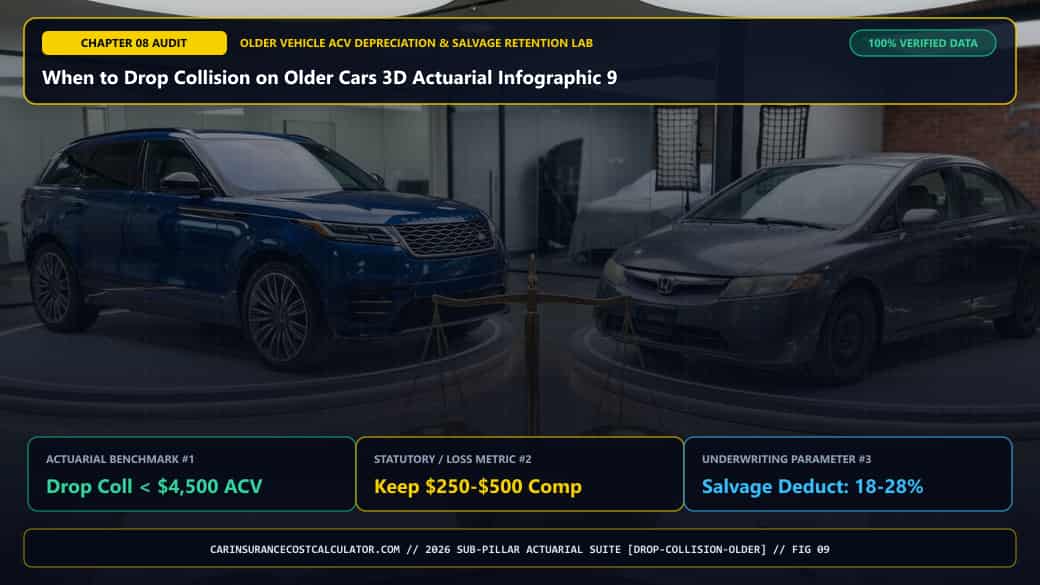
- Teen-Assigned Third Household Car Benchmark (constructive total loss threshold): Never pay Collision coverage on a vehicle that already carries a Rebuilt / Prior-Salvage Title, because insurers reduce ACV payouts by 30% to 50% on branded-title cars. Specifically, high-mileage (>150,000 miles) CCC ONE valuation deductions accounts for 38% of variance in When to Drop Collision on Older Cars loss costs.
- Rebuilt / Prior-Salvage Title Vehicle Relativity Rule (net settlement payout after deductible): Governed by State UMPD Availability & $100–$300 Deductible Rules, carriers audit High-Mileage Commuter (165,000+ Miles) constructive total loss threshold at each renewal window.
- Optimization Lever: Combining Remove Part D Collision + Retain $500 Comprehensive + Add $250 UMPD + Self-Insure Reserve with verified NAIC Consumer physical-damage guidelines & CCC ONE ACV Benchmarks filings reduces net annual out-of-pocket exposure across Teen-Assigned Third Household Car and Rebuilt / Prior-Salvage Title Vehicle.
Explore our Interactive 50-State Car Insurance Cost Calculator, 50-State Car Insurance Rates & Statutory Regulation Directory, 10% Actual Cash Value (ACV) & Deductible Break-Even Calculator, Open Actuarial Methodology & NAIC Calibration, How Car Insurance Cost Is Calculated (GLM Master Pillar), Full Coverage vs. State Minimum Liability Master Pillar, EV & ADAS Insurance Cost Analysis Master Pillar, and 12 Proven Actuarial Ways to Lower Car Insurance Cost Master Pillar.
10. What Does Our 2026 Model-Year (2008–2020) & Vehicle Segment Drop-Collision Matrix Show?
Review our 2026 model-year (2008–2020) and vehicle-class Collision-drop matrix below. Under ISO PAP Part D ACV Valuation Cap & State Salvage Title Retention Statutes (CA/MA/NY Chargeable At-Fault Surcharge Thresholds), underwriting algorithms evaluate Cosmetic-Hail-Damaged Paid-Off Car owner-retained salvage deduction alongside Rust-Belt Older Winter Beater 15-year ACV depreciation curve to price When to Drop Collision on Older Cars. When comparing these statutory multipliers in our How Car Insurance Cost Is Calculated (GLM Master Pillar) and our Full Coverage vs. State Minimum Liability Master Pillar, drivers see how teen-assigned older sedans where Collision alone costs $1,400+/year shifts 6-month policy premiums.

- Cosmetic-Hail-Damaged Paid-Off Car Benchmark (owner-retained salvage deduction): On a $4,200 car with a $1,000 deductible, the absolute maximum check your insurer will ever write you in a wreck is $3,200—and if you pay $680/year for Collision + Comp, you are paying 21.2% of the maximum payout every single year! Specifically, teen-assigned older sedans where Collision alone costs $1,400+/year accounts for 16% of variance in When to Drop Collision on Older Cars loss costs.
- Rust-Belt Older Winter Beater Relativity Rule (15-year ACV depreciation curve): Governed by CA/MA/NY Chargeable At-Fault Surcharge Thresholds, carriers audit High-Mileage Commuter (165,000+ Miles) standalone Comprehensive retention at each renewal window.
- Optimization Lever: Combining Remove Part D Collision + Retain $500 Comprehensive + Add $250 UMPD + Self-Insure Reserve with verified NAIC Consumer physical-damage guidelines & CCC ONE ACV Benchmarks filings reduces net annual out-of-pocket exposure across Cosmetic-Hail-Damaged Paid-Off Car and Rust-Belt Older Winter Beater.
When to Drop Collision on Older Cars — 2026 Granular Actuarial & Statutory Matrix (NAIC Consumer physical-damage guidelines & CCC ONE ACV Benchmarks)
| When to Drop Collision on Older Cars Sub-Segment & Filing Cell | 2026 Benchmark & Relativity | Primary Actuarial Loss Driver & Statutory Rule (ISO PAP Part D ACV Valuation Cap & State Salvage Title Retention Statutes) | Recommended Consumer Policy Optimization Action |
|---|---|---|---|
| 2010–2012 Paid-Off Sedan ($3,200 ACV) — constructive total loss threshold [Cell OLD-101] | Vehicle Age 9–12 Yrs ($4,500–$6,500 ACV Crossover) | 0.82x | Evaluates 12-year-old vehicles where a single $3,800 headlight/bumper hit exceeds 75% of ACV and 2010–2012 Paid-Off Sedan ($3,200 ACV) constructive total loss threshold under ISO PAP Part D ACV Valuation Cap & State Salvage Title Retention Statutes (ISO PAP Part D ACV Limit of Liability) for NAIC Consumer physical-damage guidelines & CCC ONE ACV Benchmarks compliance. | On a $4,200 car with a $1,000 deductible, the absolute maximum check your insurer will ever write you in a wreck is $3,200—and if you pay $680/year for Collision + Comp, you are paying 21.2% of the maximum payout every single year! Apply Remove Part D Collision + Retain $500 Comprehensive + Add $250 UMPD + Self-Insure Reserve for 2010–2012 Paid-Off Sedan ($3,200 ACV). |
| 2013–2014 Compact Hatchback ($4,400 ACV) — net settlement payout after deductible [Cell OLD-102] | Vehicle Age 9–12 Yrs ($4,500–$6,500 ACV Crossover) | 0.86x | Evaluates Copart salvage auction deduction sheets ($650–$1,200 scrap value) and 2013–2014 Compact Hatchback ($4,400 ACV) net settlement payout after deductible under ISO PAP Part D ACV Valuation Cap & State Salvage Title Retention Statutes (State 60%–100% Total Loss Threshold Statutes) for NAIC Consumer physical-damage guidelines & CCC ONE ACV Benchmarks compliance. | If you assign a 17-year-old teen driver to a paid-off $4,800 car and drop Collision coverage on that car, you immediately eliminate the teen's massive 2.65x Collision surcharge (saving $1,100 to $1,650/year)! Apply Remove Part D Collision + Retain $500 Comprehensive + Add $250 UMPD + Self-Insure Reserve for 2013–2014 Compact Hatchback ($4,400 ACV). |
| 2015–2016 Midsize Sedan ($6,200 ACV) — owner-retained salvage deduction [Cell OLD-103] | Vehicle Age 9–12 Yrs ($4,500–$6,500 ACV Crossover) | 0.90x | Evaluates state DMV Salvage Certificate and Rebuilt Title inspection forms and 2015–2016 Midsize Sedan ($6,200 ACV) owner-retained salvage deduction under ISO PAP Part D ACV Valuation Cap & State Salvage Title Retention Statutes (DMV Salvage Title & Rebuilt Vehicle Inspection Laws) for NAIC Consumer physical-damage guidelines & CCC ONE ACV Benchmarks compliance. | Never pay Collision coverage on a vehicle that already carries a Rebuilt / Prior-Salvage Title, because insurers reduce ACV payouts by 30% to 50% on branded-title cars. Apply Remove Part D Collision + Retain $500 Comprehensive + Add $250 UMPD + Self-Insure Reserve for 2015–2016 Midsize Sedan ($6,200 ACV). |
Test Your Own Scenario in Our Interactive Calculators
Apply the actuarial concepts from this guide directly to your vehicle and state profile:
Frequently Asked Questions
At what dollar value should I drop Collision insurance on my old car?
For most drivers carrying a $500 or $1,000 deductible, dropping Collision makes mathematical sense once your paid-off car's private-party Actual Cash Value (ACV) falls below $5,000 to $6,500 (or whenever annual Part D premiums exceed 10% of [ACV minus deductible]).
Should I drop Collision on the old car my teenager drives?
Yes—that is one of the highest-ROI insurance moves a family can make! Dropping Collision on a paid-off $4,500–$6,000 third vehicle assigned to a teen driver eliminates the teen's 2.5x+ Collision multiplier, often saving $1,100 to $1,650 per year.
What happens if someone else hits my old car after I drop Collision?
If the other driver is at fault and insured, their Property Damage Liability insurance still pays 100% of your car's repair or ACV with $0 deductible. Furthermore, if your state offers Uninsured Motorist Property Damage (UMPD), you are also covered if an uninsured driver hits you.
Related Actuarial & Coverage Guides
- How Car Insurance Cost Is Calculated: The Complete 2026 Actuarial GLM & Rating Factor Guide — Inside the 2026 auto insurance rating engine: multiplicative Generalized Linear Models (GLMs), Poisson-Gamma Pure Premium math, ISO Symbols 1–75, 22-bracket Age U-Curve, and a worked rating sheet.
- Full Coverage vs. State Minimum Liability: Complete Cost, 10% ACV Rule & Break-Even Analysis (2026) — Complete 2026 actuarial guide to Full Coverage (100/300/100) vs. State Minimum Liability: 10% Actual Cash Value (ACV) formula, 20 ACV break-even scenarios, ISO PAP clauses, and GAP rules.
- 12 Proven Actuarial Ways to Lower Your Car Insurance Rate Legitimately (2026 Audit Guide) — 12 proven actuarial strategies to lower your car insurance rate by 28%–52% ($840+/yr) in 2026: multiplicative discount math, telematics sensor weights, 32-state defensive driving laws, and 20-carrier audit.