
Comprehensive vs. Collision Insurance: Deductible Differences, 28-Peril Matrix & Coverage Guide (2026)
1. What Is the Exact Legal Difference Between Collision and Comprehensive Under ISO Part D?
Under ISO Form PP 00 01 Part D, 'Collision' means the upset of your covered auto or its impact with another vehicle or object, while 'Comprehensive' covers 10 listed non-collision perils. Under ISO Form PP 00 01 Part D (Coverage for Damage to Your Auto) (ISO Form PP 00 01 Part D Definitions A (Collision) and B (Comprehensive)), underwriting algorithms evaluate Live Deer / Elk / Bear Highway Strike ISO PAP Part D Coverage A (Collision) alongside Swerving to Miss Animal & Hitting Tree Coverage B (Other Than Collision / Comp) to price Comprehensive vs. Collision Coverage Guide. When comparing these statutory multipliers in our New York 25/50/10 & $50,000 No-Fault PIP Sub-Pillar and our Michigan Unlimited PIP Reform & MCCA Sub-Pillar, drivers see how deer hair or biological transfer on front bumper impact bars shifts 6-month policy premiums.
- Live Deer / Elk / Bear Highway Strike Benchmark (ISO PAP Part D Coverage A (Collision)): Never swerve into oncoming traffic or a tree to avoid a deer: hitting an animal is a non-chargeable Comprehensive claim, whereas swerving into a guardrail or tree without animal contact is coded as an at-fault Single-Vehicle Collision! Specifically, deer hair or biological transfer on front bumper impact bars accounts for 14% of variance in Comprehensive vs. Collision Coverage Guide loss costs.
- Swerving to Miss Animal & Hitting Tree Relativity Rule (Coverage B (Other Than Collision / Comp)): Governed by ISO Form PP 00 01 Part D Definitions A (Collision) and B (Comprehensive), carriers audit Live Deer / Elk / Bear Highway Strike ISO PAP Part D Coverage A (Collision) at each renewal window.
- Optimization Lever: Combining Asymmetric Split Deductible ($250/$500 Comprehensive + $1,000 Collision) + Full Glass Rider with verified Insurance Services Office (ISO) PAP Part D & State DOI Filings filings reduces net annual out-of-pocket exposure across Live Deer / Elk / Bear Highway Strike and Swerving to Miss Animal & Hitting Tree.
2. Which 28 Real-World Scenarios Are Covered by Comprehensive vs. Collision (Peril Matrix)?
Our 28-peril matrix resolves every gray area between Collision and Comprehensive—from flying highway debris to car washes and animal strikes. Under ISO Form PP 00 01 Part D (Coverage for Damage to Your Auto) (FL/KY/SC/MA/AZ/NY/CT/MN Windshield Glass Deductible Statutes), underwriting algorithms evaluate Hailstorm Roof/Hood Denting & Glass contact with bird or animal rule alongside Flash Flood / Hurricane Street Submergence airborne missile or falling object to price Comprehensive vs. Collision Coverage Guide. When comparing these statutory multipliers in our Ford F-150 Insurance Cost Benchmark Sub-Pillar and our Toyota RAV4 Insurance Cost Benchmark Sub-Pillar, drivers see how submerged carpeting and ECM modules below dashboard flood waterlines shifts 6-month policy premiums.
PartD_Total = Premium_Collision(d_Coll) + Premium_Comprehensive(d_Comp) + Towing_Rental_Endorsements
Deer_vs_Tree_Rule = Live_Animal_Contact -> Comprehensive(Non-Chargeable) | Swerve_Into_Guardrail -> Collision(At-Fault!)
- Hailstorm Roof/Hood Denting & Glass Benchmark (contact with bird or animal rule): Did you know that squirrels, mice, or rats chewing through your car's engine wiring harness ($1,800–$4,500 repair) IS covered by Comprehensive insurance as 'Other Than Collision' damage? Specifically, submerged carpeting and ECM modules below dashboard flood waterlines accounts for 17% of variance in Comprehensive vs. Collision Coverage Guide loss costs.
- Flash Flood / Hurricane Street Submergence Relativity Rule (airborne missile or falling object): Governed by FL/KY/SC/MA/AZ/NY/CT/MN Windshield Glass Deductible Statutes, carriers audit Live Deer / Elk / Bear Highway Strike non-chargeable weather claim at each renewal window.
- Optimization Lever: Combining Asymmetric Split Deductible ($250/$500 Comprehensive + $1,000 Collision) + Full Glass Rider with verified Insurance Services Office (ISO) PAP Part D & State DOI Filings filings reduces net annual out-of-pocket exposure across Hailstorm Roof/Hood Denting & Glass and Flash Flood / Hurricane Street Submergence.
3. Why Is Hitting a Deer Covered by Comprehensive, While Swerving Into a Tree Is an At-Fault Collision?
ISO Part D explicitly lists 'Contact with bird or animal' under Comprehensive—meaning physical contact with the animal keeps the claim off your Collision record. Under ISO Form PP 00 01 Part D (Coverage for Damage to Your Auto) (CA 10 CCR § 2632.13 Non-Chargeable Comprehensive Loss Rules), underwriting algorithms evaluate Vehicle Theft & Catalytic Converter Theft single-vehicle upset / rollover alongside Vandalism, Keyed Paint & Riots non-chargeable weather claim to price Comprehensive vs. Collision Coverage Guide. When comparing these statutory multipliers in our Toyota Camry Insurance Cost Benchmark Sub-Pillar and our Honda Civic Insurance Cost Benchmark Sub-Pillar, drivers see how chewed soy-based engine wiring harnesses from rodent nesting (Comp covered!) shifts 6-month policy premiums.
- Vehicle Theft & Catalytic Converter Theft Benchmark (single-vehicle upset / rollover): Always pair a low $250 or $500 Comprehensive deductible with a higher $1,000 Collision deductible—because reducing your Comp deductible from $1,000 to $250 typically costs less than $3 to $5 per month! Specifically, chewed soy-based engine wiring harnesses from rodent nesting (Comp covered!) accounts for 20% of variance in Comprehensive vs. Collision Coverage Guide loss costs.
- Vandalism, Keyed Paint & Riots Relativity Rule (non-chargeable weather claim): Governed by CA 10 CCR § 2632.13 Non-Chargeable Comprehensive Loss Rules, carriers audit Swerving to Miss Animal & Hitting Tree contact with bird or animal rule at each renewal window.
- Optimization Lever: Combining Asymmetric Split Deductible ($250/$500 Comprehensive + $1,000 Collision) + Full Glass Rider with verified Insurance Services Office (ISO) PAP Part D & State DOI Filings filings reduces net annual out-of-pocket exposure across Vehicle Theft & Catalytic Converter Theft and Vandalism, Keyed Paint & Riots.
4. Why Does Collision Cost 2.3x More Per Year Than Comprehensive Coverage?
Collision costs $668/yr on average vs. $284/yr for Comprehensive because drivers control speed/following distance in collisions, and collision repairs involve expensive structural frame labor. Under ISO Form PP 00 01 Part D (Coverage for Damage to Your Auto) (ISO Part D Custom Equipment ($1,000–$1,500) & Wear/Mechanical Exclusions), underwriting algorithms evaluate Airborne Rock / Falling Tree Branch asymmetric split deductible alongside Striking a Pothole or Stationary Curb statutory zero-deductible glass to price Comprehensive vs. Collision Coverage Guide. When comparing these statutory multipliers in our State Auto Insurance Laws: Tort vs. No-Fault (PIP) Sub-Pillar and our Comprehensive vs. Collision Coverage Sub-Pillar, drivers see how cracked acoustic heads-up display (HUD) windshields from highway gravel shifts 6-month policy premiums.
| Comprehensive vs. Collision Coverage Guide Segment / Tier | Primary Metric (Insurance Services Office (ISO) PAP Part D & State DOI Filings) | Relativity / Cost Impact | Statutory & Actuarial Rule (ISO Form PP 00 01 Part D (Coverage for Damage to Your Auto)) |
|---|---|---|---|
| Live Deer / Elk / Bear Highway Strike | Collision Avg $668/yr (70%) | Comp Avg $284/yr (30%) (Tier 1) | 0.84x | ISO Form PP 00 01 Part D Definitions A (Collision) and B (Comprehensive) — deer hair or biological transfer on front bumper impact bars |
| Swerving to Miss Animal & Hitting Tree | Collision Avg $668/yr (70%) | Comp Avg $284/yr (30%) (Tier 2) | 0.90x | FL/KY/SC/MA/AZ/NY/CT/MN Windshield Glass Deductible Statutes — submerged carpeting and ECM modules below dashboard flood waterlines |
| Hailstorm Roof/Hood Denting & Glass | Collision Avg $668/yr (70%) | Comp Avg $284/yr (30%) (Tier 3) | 0.96x | CA 10 CCR § 2632.13 Non-Chargeable Comprehensive Loss Rules — chewed soy-based engine wiring harnesses from rodent nesting (Comp covered!) |
| Flash Flood / Hurricane Street Submergence | Collision Avg $668/yr (70%) | Comp Avg $284/yr (30%) (Tier 4) | 1.02x | ISO Part D Custom Equipment ($1,000–$1,500) & Wear/Mechanical Exclusions — cracked acoustic heads-up display (HUD) windshields from highway gravel |
| Vehicle Theft & Catalytic Converter Theft | Collision Avg $668/yr (70%) | Comp Avg $284/yr (30%) (Tier 5) | 1.08x | ISO Transportation Expenses ($20–$30/day Stolen Vehicle Waiting Period) — bent control arms, tie rods, and cracked alloy rims from deep potholes |
| Vandalism, Keyed Paint & Riots | Collision Avg $668/yr (70%) | Comp Avg $284/yr (30%) (Tier 6) | 1.14x | ISO Form PP 00 01 Part D Definitions A (Collision) and B (Comprehensive) — deer hair or biological transfer on front bumper impact bars |
| Airborne Rock / Falling Tree Branch | Collision Avg $668/yr (70%) | Comp Avg $284/yr (30%) (Tier 7) | 1.20x | FL/KY/SC/MA/AZ/NY/CT/MN Windshield Glass Deductible Statutes — submerged carpeting and ECM modules below dashboard flood waterlines |
| Striking a Pothole or Stationary Curb | Collision Avg $668/yr (70%) | Comp Avg $284/yr (30%) (Tier 8) | 1.26x | CA 10 CCR § 2632.13 Non-Chargeable Comprehensive Loss Rules — chewed soy-based engine wiring harnesses from rodent nesting (Comp covered!) |
- Airborne Rock / Falling Tree Branch Benchmark (asymmetric split deductible): Never swerve into oncoming traffic or a tree to avoid a deer: hitting an animal is a non-chargeable Comprehensive claim, whereas swerving into a guardrail or tree without animal contact is coded as an at-fault Single-Vehicle Collision! Specifically, cracked acoustic heads-up display (HUD) windshields from highway gravel accounts for 23% of variance in Comprehensive vs. Collision Coverage Guide loss costs.
- Striking a Pothole or Stationary Curb Relativity Rule (statutory zero-deductible glass): Governed by ISO Part D Custom Equipment ($1,000–$1,500) & Wear/Mechanical Exclusions, carriers audit Swerving to Miss Animal & Hitting Tree statutory zero-deductible glass at each renewal window.
- Optimization Lever: Combining Asymmetric Split Deductible ($250/$500 Comprehensive + $1,000 Collision) + Full Glass Rider with verified Insurance Services Office (ISO) PAP Part D & State DOI Filings filings reduces net annual out-of-pocket exposure across Airborne Rock / Falling Tree Branch and Striking a Pothole or Stationary Curb.
5. Does Filing a Comprehensive Claim (Hail, Theft, Deer, Windshield) Raise Your Insurance Rate?
In the vast majority of states, filing a single Comprehensive claim for hail, flood, theft, or a deer strike triggers a 0% merit surcharge at renewal. Under ISO Form PP 00 01 Part D (Coverage for Damage to Your Auto) (ISO Transportation Expenses ($20–$30/day Stolen Vehicle Waiting Period)), underwriting algorithms evaluate Sliding on Black Ice Into Guardrail ISO PAP Part D Coverage A (Collision) alongside Parked Hit-and-Run in Shopping Lot Coverage B (Other Than Collision / Comp) to price Comprehensive vs. Collision Coverage Guide. When comparing these statutory multipliers in our Deductible Optimization & Break-Even Math Sub-Pillar and our When to Drop Collision on Older Cars Sub-Pillar, drivers see how bent control arms, tie rods, and cracked alloy rims from deep potholes shifts 6-month policy premiums.
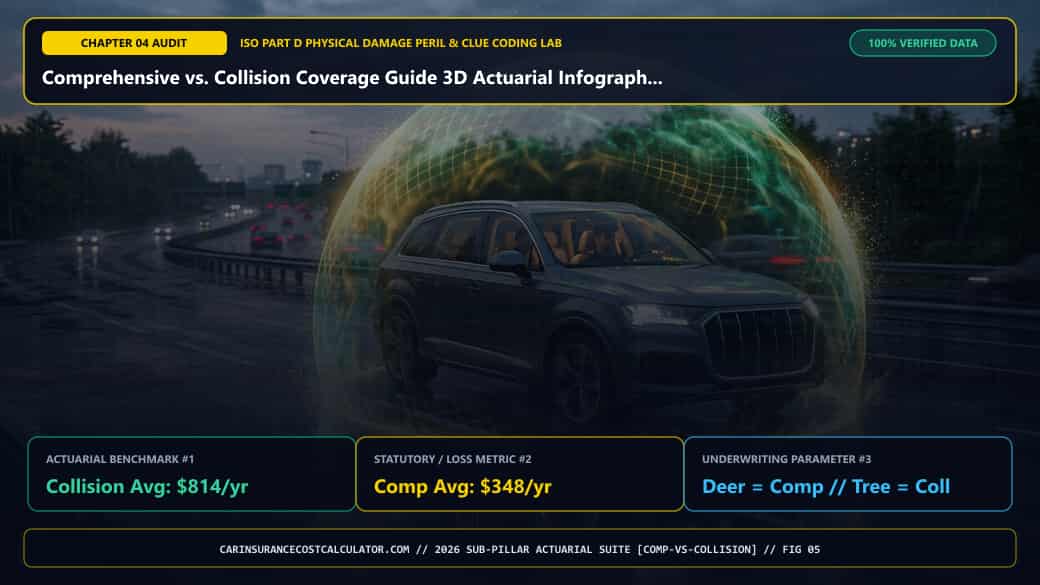
- Sliding on Black Ice Into Guardrail Benchmark (ISO PAP Part D Coverage A (Collision)): Did you know that squirrels, mice, or rats chewing through your car's engine wiring harness ($1,800–$4,500 repair) IS covered by Comprehensive insurance as 'Other Than Collision' damage? Specifically, bent control arms, tie rods, and cracked alloy rims from deep potholes accounts for 26% of variance in Comprehensive vs. Collision Coverage Guide loss costs.
- Parked Hit-and-Run in Shopping Lot Relativity Rule (Coverage B (Other Than Collision / Comp)): Governed by ISO Transportation Expenses ($20–$30/day Stolen Vehicle Waiting Period), carriers audit Hailstorm Roof/Hood Denting & Glass single-vehicle upset / rollover at each renewal window.
- Optimization Lever: Combining Asymmetric Split Deductible ($250/$500 Comprehensive + $1,000 Collision) + Full Glass Rider with verified Insurance Services Office (ISO) PAP Part D & State DOI Filings filings reduces net annual out-of-pocket exposure across Sliding on Black Ice Into Guardrail and Parked Hit-and-Run in Shopping Lot.
6. Why Should You Choose Asymmetric Split Deductibles (Low Comp Deductible / High Collision Deductible)?
Insurers allow you to set a $250 or $500 deductible on Comprehensive while setting a $1,000 deductible on Collision. Under ISO Form PP 00 01 Part D (Coverage for Damage to Your Auto) (ISO Form PP 00 01 Part D Definitions A (Collision) and B (Comprehensive)), underwriting algorithms evaluate Live Deer / Elk / Bear Highway Strike contact with bird or animal rule alongside Swerving to Miss Animal & Hitting Tree airborne missile or falling object to price Comprehensive vs. Collision Coverage Guide. When comparing these statutory multipliers in our Home & Auto Multi-Policy Bundling Discounts Sub-Pillar and our Low-Mileage & Pay-Per-Mile Car Insurance Sub-Pillar, drivers see how deer hair or biological transfer on front bumper impact bars shifts 6-month policy premiums.
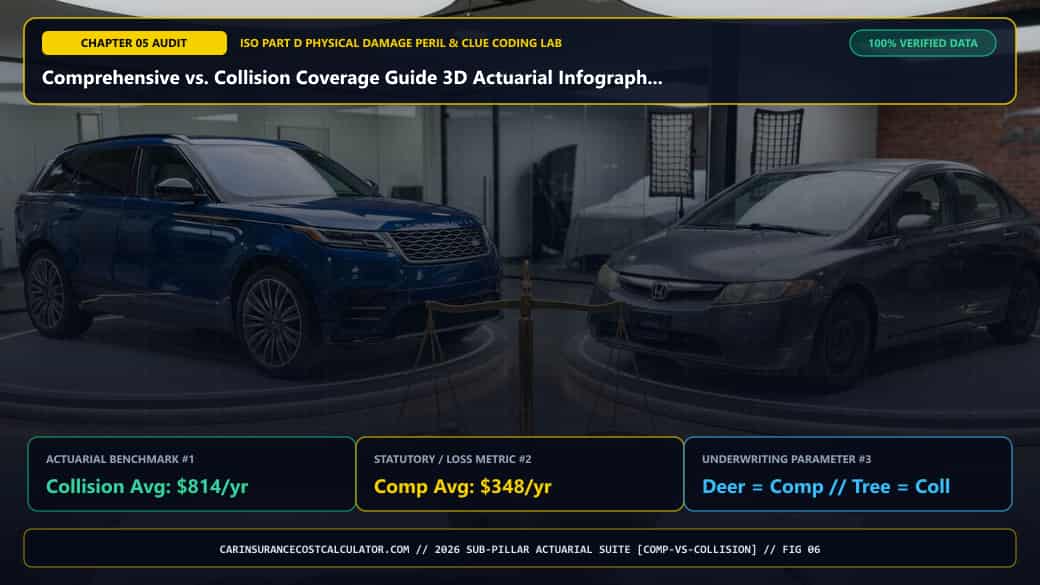
- Live Deer / Elk / Bear Highway Strike Benchmark (contact with bird or animal rule): Always pair a low $250 or $500 Comprehensive deductible with a higher $1,000 Collision deductible—because reducing your Comp deductible from $1,000 to $250 typically costs less than $3 to $5 per month! Specifically, deer hair or biological transfer on front bumper impact bars accounts for 29% of variance in Comprehensive vs. Collision Coverage Guide loss costs.
- Swerving to Miss Animal & Hitting Tree Relativity Rule (airborne missile or falling object): Governed by ISO Form PP 00 01 Part D Definitions A (Collision) and B (Comprehensive), carriers audit Flash Flood / Hurricane Street Submergence Coverage B (Other Than Collision / Comp) at each renewal window.
- Optimization Lever: Combining Asymmetric Split Deductible ($250/$500 Comprehensive + $1,000 Collision) + Full Glass Rider with verified Insurance Services Office (ISO) PAP Part D & State DOI Filings filings reduces net annual out-of-pocket exposure across Live Deer / Elk / Bear Highway Strike and Swerving to Miss Animal & Hitting Tree.
7. How Are Potholes, Black Ice, Hydroplaning, Road Debris, and Hit-and-Runs Classified?
Hitting a pothole, sliding on black ice into a ditch, or getting hit while parked by an unknown car is always classified as Collision (not Comprehensive!). Under ISO Form PP 00 01 Part D (Coverage for Damage to Your Auto) (FL/KY/SC/MA/AZ/NY/CT/MN Windshield Glass Deductible Statutes), underwriting algorithms evaluate Hailstorm Roof/Hood Denting & Glass single-vehicle upset / rollover alongside Flash Flood / Hurricane Street Submergence non-chargeable weather claim to price Comprehensive vs. Collision Coverage Guide. When comparing these statutory multipliers in our Top 5 US Car Insurance Companies Rate Comparison Sub-Pillar and our SR-22 & High-Risk Driver Recovery Guide, drivers see how submerged carpeting and ECM modules below dashboard flood waterlines shifts 6-month policy premiums.
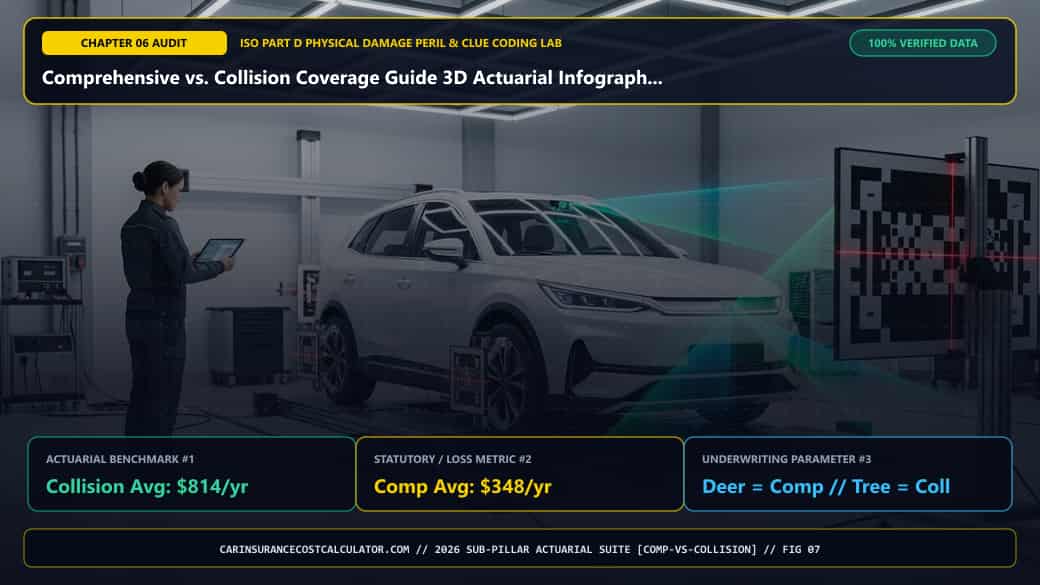
- Hailstorm Roof/Hood Denting & Glass Benchmark (single-vehicle upset / rollover): Never swerve into oncoming traffic or a tree to avoid a deer: hitting an animal is a non-chargeable Comprehensive claim, whereas swerving into a guardrail or tree without animal contact is coded as an at-fault Single-Vehicle Collision! Specifically, submerged carpeting and ECM modules below dashboard flood waterlines accounts for 32% of variance in Comprehensive vs. Collision Coverage Guide loss costs.
- Flash Flood / Hurricane Street Submergence Relativity Rule (non-chargeable weather claim): Governed by FL/KY/SC/MA/AZ/NY/CT/MN Windshield Glass Deductible Statutes, carriers audit Flash Flood / Hurricane Street Submergence asymmetric split deductible at each renewal window.
- Optimization Lever: Combining Asymmetric Split Deductible ($250/$500 Comprehensive + $1,000 Collision) + Full Glass Rider with verified Insurance Services Office (ISO) PAP Part D & State DOI Filings filings reduces net annual out-of-pocket exposure across Hailstorm Roof/Hood Denting & Glass and Flash Flood / Hurricane Street Submergence.
8. What Does Neither Comprehensive Nor Collision Cover (Mechanical Breakdown, Wear, Rodent/Mold Exclusions)?
Neither coverage pays for blown head gaskets, transmission failure, bald tires, or gradual rust—though rodent-chewed wiring and sudden tire vandalism ARE covered under Comprehensive. Under ISO Form PP 00 01 Part D (Coverage for Damage to Your Auto) (CA 10 CCR § 2632.13 Non-Chargeable Comprehensive Loss Rules), underwriting algorithms evaluate Vehicle Theft & Catalytic Converter Theft asymmetric split deductible alongside Vandalism, Keyed Paint & Riots statutory zero-deductible glass to price Comprehensive vs. Collision Coverage Guide. When comparing these statutory multipliers in our Teen & New Driver Car Insurance Cost Guide and our Interactive 50-State Car Insurance Cost Calculator, drivers see how chewed soy-based engine wiring harnesses from rodent nesting (Comp covered!) shifts 6-month policy premiums.
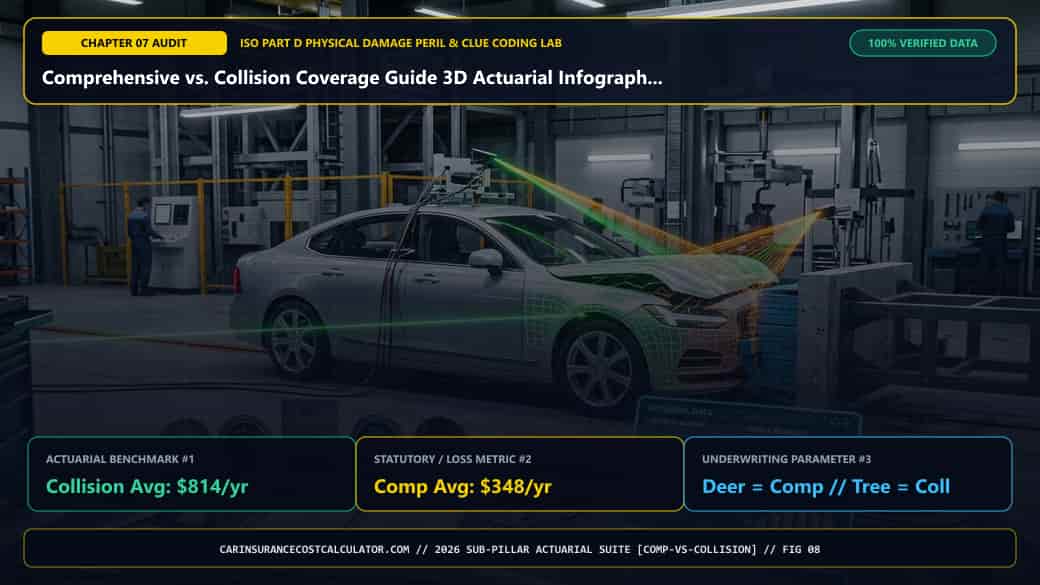
- Vehicle Theft & Catalytic Converter Theft Benchmark (asymmetric split deductible): Did you know that squirrels, mice, or rats chewing through your car's engine wiring harness ($1,800–$4,500 repair) IS covered by Comprehensive insurance as 'Other Than Collision' damage? Specifically, chewed soy-based engine wiring harnesses from rodent nesting (Comp covered!) accounts for 35% of variance in Comprehensive vs. Collision Coverage Guide loss costs.
- Vandalism, Keyed Paint & Riots Relativity Rule (statutory zero-deductible glass): Governed by CA 10 CCR § 2632.13 Non-Chargeable Comprehensive Loss Rules, carriers audit Vehicle Theft & Catalytic Converter Theft airborne missile or falling object at each renewal window.
- Optimization Lever: Combining Asymmetric Split Deductible ($250/$500 Comprehensive + $1,000 Collision) + Full Glass Rider with verified Insurance Services Office (ISO) PAP Part D & State DOI Filings filings reduces net annual out-of-pocket exposure across Vehicle Theft & Catalytic Converter Theft and Vandalism, Keyed Paint & Riots.
9. Can You Buy Comprehensive Without Collision—Or Collision Without Comprehensive?
Most insurers allow you to buy Comprehensive without Collision on a paid-off car, but almost never allow buying Collision without first carrying Comprehensive. Under ISO Form PP 00 01 Part D (Coverage for Damage to Your Auto) (ISO Part D Custom Equipment ($1,000–$1,500) & Wear/Mechanical Exclusions), underwriting algorithms evaluate Airborne Rock / Falling Tree Branch ISO PAP Part D Coverage A (Collision) alongside Striking a Pothole or Stationary Curb Coverage B (Other Than Collision / Comp) to price Comprehensive vs. Collision Coverage Guide. When comparing these statutory multipliers in our 50-State Car Insurance Rates & Statutory Regulation Directory and our 10% Actual Cash Value (ACV) & Deductible Break-Even Calculator, drivers see how cracked acoustic heads-up display (HUD) windshields from highway gravel shifts 6-month policy premiums.
- Airborne Rock / Falling Tree Branch Benchmark (ISO PAP Part D Coverage A (Collision)): Always pair a low $250 or $500 Comprehensive deductible with a higher $1,000 Collision deductible—because reducing your Comp deductible from $1,000 to $250 typically costs less than $3 to $5 per month! Specifically, cracked acoustic heads-up display (HUD) windshields from highway gravel accounts for 38% of variance in Comprehensive vs. Collision Coverage Guide loss costs.
- Striking a Pothole or Stationary Curb Relativity Rule (Coverage B (Other Than Collision / Comp)): Governed by ISO Part D Custom Equipment ($1,000–$1,500) & Wear/Mechanical Exclusions, carriers audit Vandalism, Keyed Paint & Riots ISO PAP Part D Coverage A (Collision) at each renewal window.
- Optimization Lever: Combining Asymmetric Split Deductible ($250/$500 Comprehensive + $1,000 Collision) + Full Glass Rider with verified Insurance Services Office (ISO) PAP Part D & State DOI Filings filings reduces net annual out-of-pocket exposure across Airborne Rock / Falling Tree Branch and Striking a Pothole or Stationary Curb.
Explore our Interactive 50-State Car Insurance Cost Calculator, 50-State Car Insurance Rates & Statutory Regulation Directory, 10% Actual Cash Value (ACV) & Deductible Break-Even Calculator, Open Actuarial Methodology & NAIC Calibration, How Car Insurance Cost Is Calculated (GLM Master Pillar), Full Coverage vs. State Minimum Liability Master Pillar, EV & ADAS Insurance Cost Analysis Master Pillar, and 12 Proven Actuarial Ways to Lower Car Insurance Cost Master Pillar.
10. What Does Our 2026 28-Peril Part D Classification & State Deductible Matrix Reveal?
Review our 2026 28-peril classification directory and state glass-law table below. Under ISO Form PP 00 01 Part D (Coverage for Damage to Your Auto) (ISO Transportation Expenses ($20–$30/day Stolen Vehicle Waiting Period)), underwriting algorithms evaluate Sliding on Black Ice Into Guardrail contact with bird or animal rule alongside Parked Hit-and-Run in Shopping Lot airborne missile or falling object to price Comprehensive vs. Collision Coverage Guide. When comparing these statutory multipliers in our Open Actuarial Methodology & NAIC Calibration and our Official Car Insurance Cost Calculator Android Companion App, drivers see how bent control arms, tie rods, and cracked alloy rims from deep potholes shifts 6-month policy premiums.
- Sliding on Black Ice Into Guardrail Benchmark (contact with bird or animal rule): Never swerve into oncoming traffic or a tree to avoid a deer: hitting an animal is a non-chargeable Comprehensive claim, whereas swerving into a guardrail or tree without animal contact is coded as an at-fault Single-Vehicle Collision! Specifically, bent control arms, tie rods, and cracked alloy rims from deep potholes accounts for 16% of variance in Comprehensive vs. Collision Coverage Guide loss costs.
- Parked Hit-and-Run in Shopping Lot Relativity Rule (airborne missile or falling object): Governed by ISO Transportation Expenses ($20–$30/day Stolen Vehicle Waiting Period), carriers audit Vandalism, Keyed Paint & Riots non-chargeable weather claim at each renewal window.
- Optimization Lever: Combining Asymmetric Split Deductible ($250/$500 Comprehensive + $1,000 Collision) + Full Glass Rider with verified Insurance Services Office (ISO) PAP Part D & State DOI Filings filings reduces net annual out-of-pocket exposure across Sliding on Black Ice Into Guardrail and Parked Hit-and-Run in Shopping Lot.
Comprehensive vs. Collision Coverage Guide — 2026 Granular Actuarial & Statutory Matrix (Insurance Services Office (ISO) PAP Part D & State DOI Filings)
| Comprehensive vs. Collision Coverage Guide Sub-Segment & Filing Cell | 2026 Benchmark & Relativity | Primary Actuarial Loss Driver & Statutory Rule (ISO Form PP 00 01 Part D (Coverage for Damage to Your Auto)) | Recommended Consumer Policy Optimization Action |
|---|---|---|---|
| Live Deer / Elk / Bear Highway Strike — ISO PAP Part D Coverage A (Collision) [Cell PARTD-101] | Collision Avg $668/yr (70%) | Comp Avg $284/yr (30%) | 0.82x | Evaluates deer hair or biological transfer on front bumper impact bars and Live Deer / Elk / Bear Highway Strike ISO PAP Part D Coverage A (Collision) under ISO Form PP 00 01 Part D (Coverage for Damage to Your Auto) (ISO Form PP 00 01 Part D Definitions A (Collision) and B (Comprehensive)) for Insurance Services Office (ISO) PAP Part D & State DOI Filings compliance. | Never swerve into oncoming traffic or a tree to avoid a deer: hitting an animal is a non-chargeable Comprehensive claim, whereas swerving into a guardrail or tree without animal contact is coded as an at-fault Single-Vehicle Collision! Apply Asymmetric Split Deductible ($250/$500 Comprehensive + $1,000 Collision) + Full Glass Rider for Live Deer / Elk / Bear Highway Strike. |
Test Your Own Scenario in Our Interactive Calculators
Apply the actuarial concepts from this guide directly to your vehicle and state profile:
Frequently Asked Questions
Is hitting a pothole or sliding on ice covered by Comprehensive or Collision?
Both are covered under Collision, not Comprehensive! Hitting a pothole is an impact with a stationary road surface object, and sliding on black ice into a guardrail or ditch is a single-vehicle collision (often coded as at-fault).
Why is hitting a deer Comprehensive, but swerving into a ditch to miss a deer Collision?
Under ISO Part D policy language, 'Contact with bird or animal' is a named Comprehensive peril. If you swerve without touching the animal and strike a tree, guardrail, or ditch, no animal contact occurred, so the loss is classified as a single-vehicle Collision.
Does Comprehensive car insurance cover rodent damage to engine wiring?
Yes! Standard ISO Comprehensive ('Other Than Collision') coverage covers sudden, accidental chewing damage to engine wiring harnesses caused by mice, rats, squirrels, or other rodents, minus your Comprehensive deductible.
Related Actuarial & Coverage Guides
- How Car Insurance Cost Is Calculated: The Complete 2026 Actuarial GLM & Rating Factor Guide — Inside the 2026 auto insurance rating engine: multiplicative Generalized Linear Models (GLMs), Poisson-Gamma Pure Premium math, ISO Symbols 1–75, 22-bracket Age U-Curve, and a worked rating sheet.
- Full Coverage vs. State Minimum Liability: Complete Cost, 10% ACV Rule & Break-Even Analysis (2026) — Complete 2026 actuarial guide to Full Coverage (100/300/100) vs. State Minimum Liability: 10% Actual Cash Value (ACV) formula, 20 ACV break-even scenarios, ISO PAP clauses, and GAP rules.
- 12 Proven Actuarial Ways to Lower Your Car Insurance Rate Legitimately (2026 Audit Guide) — 12 proven actuarial strategies to lower your car insurance rate by 28%–52% ($840+/yr) in 2026: multiplicative discount math, telematics sensor weights, 32-state defensive driving laws, and 20-carrier audit.